Connectivity & platforms
cTrader FIX API vs Open API: Choose the Right Connection
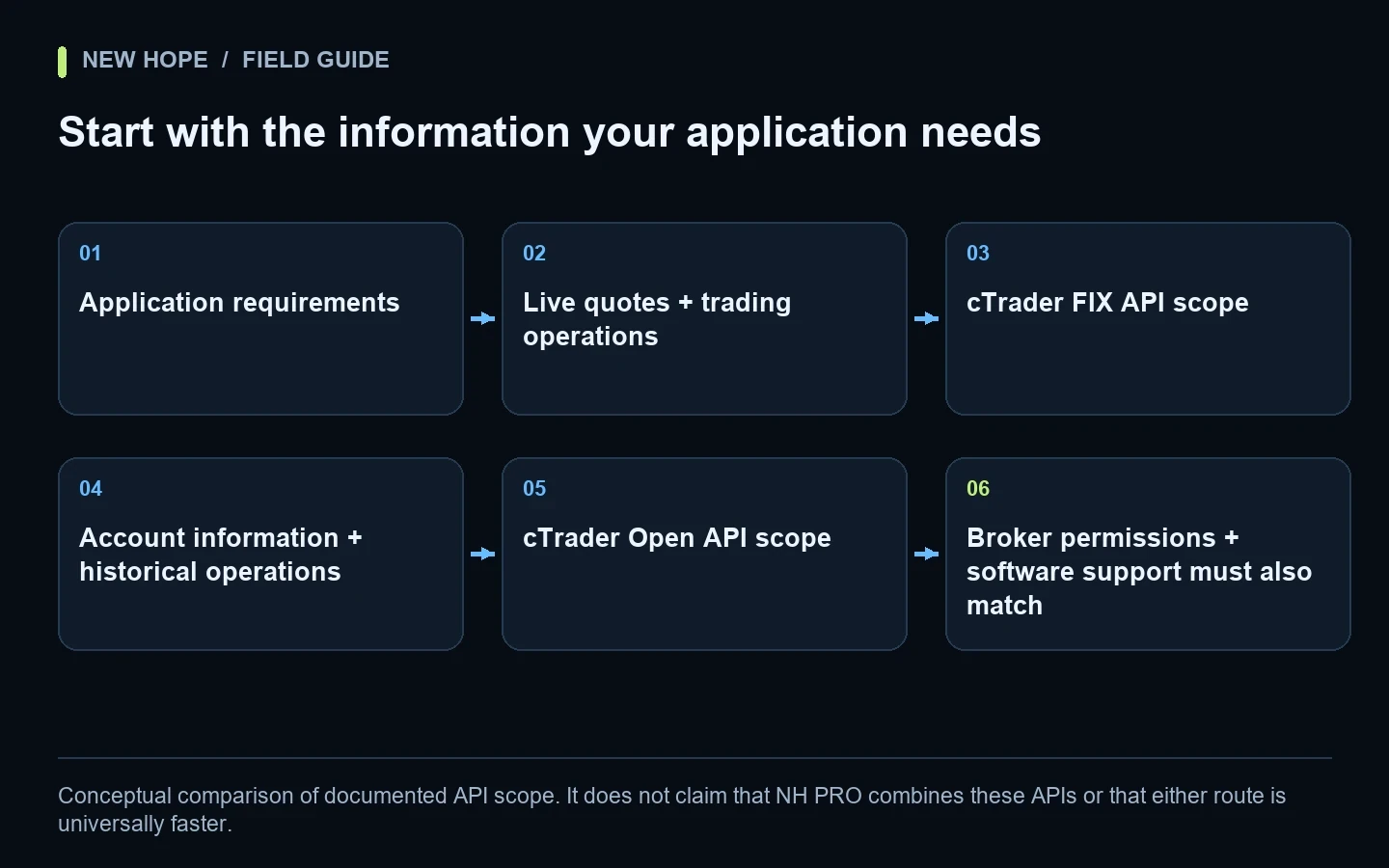
“Supports cTrader” and “supports FIX API” are useful starting points, but they do not describe an entire trading integration. Before choosing a connection, list the information the application must receive and the actions it must perform. A protocol name is not a substitute for that list.
This guide compares the documented scope of cTrader FIX API and cTrader Open API. It is intended for traders evaluating software and for teams preparing a connection specification. It is not a latency benchmark, and it does not claim that a particular application implements every capability of either API.
Conceptual comparison of documented API scope. It does not claim that NH PRO combines these APIs or that either route is universally faster.
Three layers must fit together
A working setup needs agreement between three layers: the platform's API, the broker account's permissions and the application's implementation. A capability documented by the platform may still require a suitable account and explicit support in the software.
Think of compatibility as an intersection. If the API provides an operation but the application never implements it, the operation is not available through that application. If the application can send it but the account is not permitted to use it, the request may fail. A successful login proves only part of the chain.
Write requirements in plain language first: receive current prices, place the intended order type, see whether it filled, inspect existing positions, obtain the account information needed by the strategy, and recover safely after a disconnect.
What cTrader FIX API is designed to do
FIX is a financial messaging protocol. cTrader's FIX interface focuses on receiving live market data and performing trading operations. Its documented limitations include the absence of historical market-data requests and account information such as current balance, leverage and margin. See the official introduction and limitations.
Those boundaries are useful design information. They tell an evaluator which questions require another supported source or a different integration approach. They are not a reason to fill missing values with assumptions.
For example, a system that needs current account balance to decide whether an action is permitted must explain where that information comes from. Receiving current quotes does not answer the balance question. Receiving an execution message does not automatically produce a complete historical account statement.
What Open API adds to the comparison
cTrader Open API supports custom applications connected to the cTrader backend. Its documentation describes real-time market data, trading operations and access to past, current and pending operations. It also describes application authentication and request limits. See Open API's official overview.
For a purchaser, the practical question is not whether this sounds broader. It is whether the chosen software exposes the required functions, handles their responses and documents the relevant limitations. Broader platform scope does not prove a particular product is a better match.
Requirement | cTrader FIX API | cTrader Open API |
|---|---|---|
Current market data | Within documented scope | Within documented scope |
Trading operations | Within documented FIX scope | Within documented Open API scope |
Historical market data | Not provided by this FIX interface | Check supported historical requests and limits |
Balance and margin information | Not provided by this FIX interface | Check the required account-data fields |
Application compatibility | Must be confirmed separately | Must be confirmed separately |
Worked example: a narrow execution requirement
Consider a hypothetical application that receives an external signal and needs current quotes, order submission and execution responses for one authorized account. It does not use historical candles in the connection itself.
A first review could map those requirements to the documented FIX scope. That is only the beginning. The reviewer still needs the exact order types, supported instrument identifiers, account rules and recovery behavior. The phrase “FIX supported” does not answer whether every intended action is implemented.
Create a short acceptance test: connect to the appropriate test environment, identify the instrument, obtain a current quote, submit an authorized test instruction and reconcile its final state. Record observed responses rather than treating the connection light as the test result. Do not perform live trades merely to complete a software checklist.
Worked example: a dashboard and trading workflow
Now imagine a different application that needs the current account state, a list of past operations and current positions before it permits a new action. This has a broader information requirement than the previous example.
The review should identify each required field and its authoritative source. “Balance” needs a clear timestamp and account identity. “History” needs a defined period and a way to detect incomplete results. “Current positions” needs reconciliation after reconnecting. A screen that displays plausible values is not enough if their source and freshness are unknown.
Open API may be relevant to this broader requirement, or an application may use a documented combination of supported sources. That is an architectural possibility, not a claim about how NH PRO is built. Ask the vendor to describe the actual route used by your configuration.
Credentials are part of the connection specification
cTrader documents how to obtain FIX connection details in its credential guide. Follow the current official process for the intended account and environment. Do not substitute settings from a different account because the broker's brand name matches.
Maintain a private inventory with account identity, environment, endpoint, purpose and the application that uses the connection. Keep secret values out of shared screenshots and support messages. If you need to ask for help, provide the non-secret identifiers and exact error while following the provider's secure support process.
After any credential change, verify the intended connection before resuming operation. A saved profile that still contains an old endpoint or account identifier can cause confusion even when the password itself is correct.
Why a protocol choice is not a speed result
An API's design and an observed execution outcome are different kinds of evidence. Network path, application handling, request content, broker processing and market conditions can all matter to the measured sequence. A protocol label alone does not tell you what your account will experience.
Define the measurement endpoints first. Are you measuring receipt of a quote, submission of a request, acknowledgement, or a completed fill? Comparing unlike intervals can produce an impressive-looking number that answers no useful question.
Use the execution audit to organize those timestamps. If you are reviewing historical inputs, the tick-data guide explains another distinction: access to a current stream does not establish the quality or availability of historical test data.
A practical checklist before selecting the route
List required data fields and actions without naming a protocol.
Match each requirement to the platform's current documentation.
Confirm broker, account type, environment and permissions.
Ask the software provider which functions are implemented in the specific build.
Define a test for order status and position reconciliation.
Document disconnect, uncertain-response and credential-rotation procedures.
Keep a dated record of the approved combination.
If orders are rejected, preserve the actual response and use the diagnostic guide. Do not switch connection types randomly while also changing strategy parameters; that makes it difficult to establish what fixed the problem.
How this relates to NH PRO
NH PRO 1.5.24 supports MetaTrader 4/5, FIX API and cTrader connectivity. That confirmed product scope does not establish which cTrader API is used internally by each connection, or promise that every broker/account combination is suitable.
The accompanying video opens at an NH PRO discussion of order settings and FIX-related context. It is product orientation, not a demonstration of the entire cTrader API comparison. For actual setup, follow the NH PRO connection guide and request confirmation of the exact route.
The full $5,000 package includes broker information, prepared broker/instrument settings and manager assistance. The one-time $500 month is for personal evaluation of the robot and instructions only, with no broker list, prepared settings or help configuring profitable trading. Review the product options before choosing. Technical compatibility does not guarantee trading results.
Common questions
Does cTrader support mean an application uses Open API?
No. Ask the provider which interface and functions the specific connection implements.
Can FIX supply everything needed for a performance dashboard?
Not by assumption. cTrader explicitly limits its FIX interface; identify the documented source for any additional data.
Which connection is faster?
This comparison does not measure speed. Evaluate the exact deployment and clearly defined events rather than declaring a universal winner.
Related video
Watch the referenced video on YouTube
More articles