Prop trading
Trading Between Two Prop Firms: What 2Legs Changes—and What It Cannot
Prop trading · Two-account systems · Updated 19 October 2026
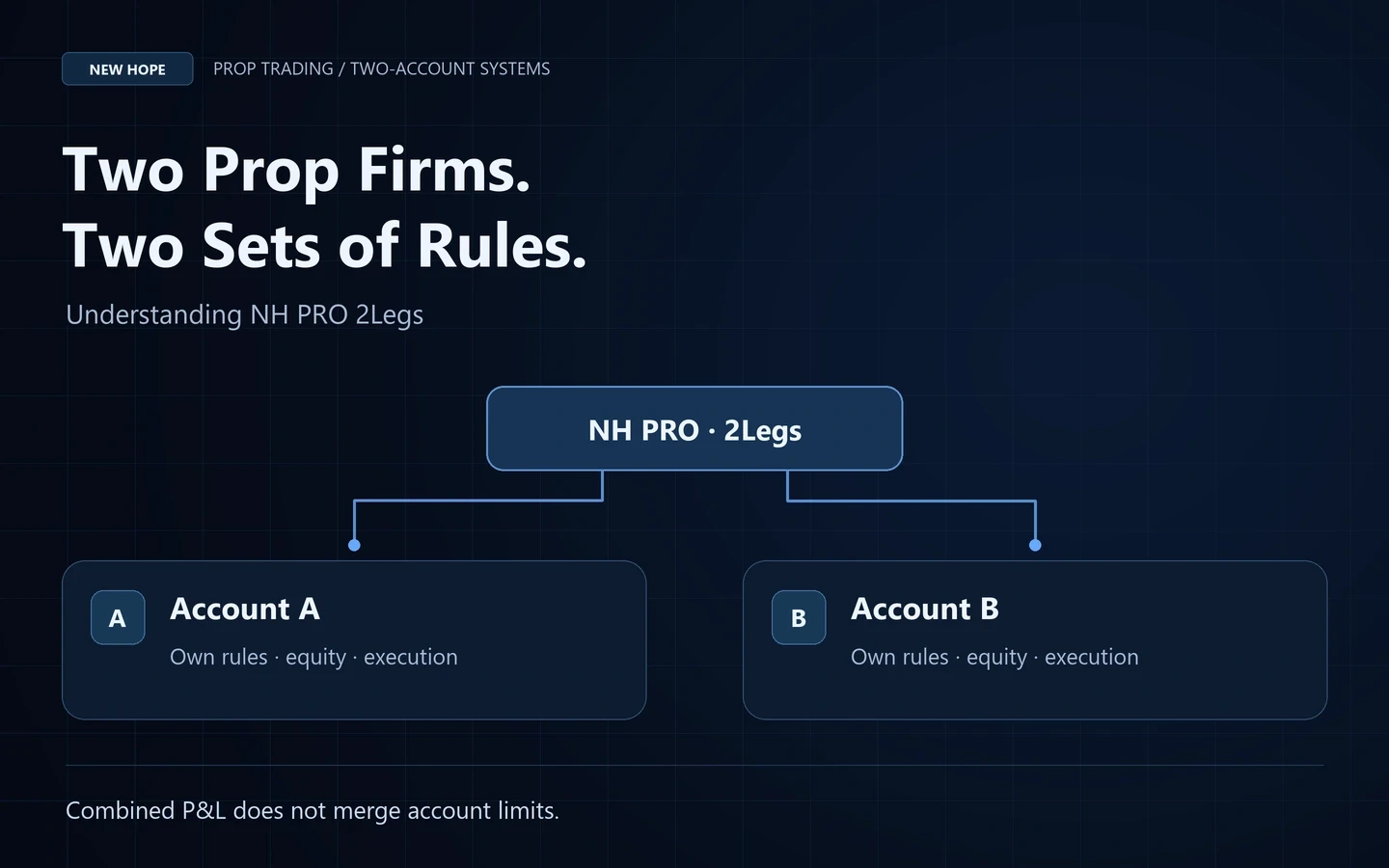
One account buys, another sells. On a diagram, the exposure appears to cancel. In practice, the accounts have separate execution, separate loss limits and separate contracts. A two-account robot does not combine them into one approved, risk-free portfolio.
This is the central question behind using New Hope PRO’s 2Legs family with prop firms. Software may coordinate actions across accounts, but a provider can prohibit the arrangement. Even where an arrangement is permitted, one account can breach its own limit while the combined result looks acceptable.
What the New Hope demonstration actually shows
The NH PRO manual and linked training describe 2Legs as a two-account strategy family and Smart2Legs as a variant involving multiple locks and auto lot. The training stresses monitoring both account states because results can accumulate unevenly. Confirm the precise mode and its behaviour in your installed build before using it.
The English explanation begins at 28:46 for 2Legs and 30:35 for Smart2Legs. These are product explanations, not demonstrations that two named prop firms have approved the strategy or paid its results.
The first gate is permission on both sides
Read both contracts before comparing prices or arranging the servers. The examples below concern the providers’ published forex/CFD programme rules; do not assume the same terms apply to separate futures offerings. FundedNext explicitly prohibits arbitrage and hedging across accounts, while allowing hedging within the same account under its stated rules. FTMO bars manipulative opposing trades across connected accounts or providers, as well as exploitation of price-update delays. The5ers excludes hedge, reverse and latency arbitrage from permitted EA use.
Those policies do not support a blanket claim that two prop firms can be traded against one another with NH PRO. See the primary policies from FundedNext, FTMO and The5ers, checked on 19 October 2026.
Owning both accounts does not itself settle the question. Neither does changing a strategy’s name, slowing its operation or using separate providers. Describe the economic behaviour accurately: whether positions oppose one another, how the signal is generated and how losses or gains can move between accounts. If the arrangement is disallowed, stop at that decision; a technical workaround is not permission.
Why a flat combined result can conceal a failed account
Consider two hypothetical accounts, each starting with $100,000. For this example only, assume both contracts prohibit equity falling below $95,000. This simplified fixed boundary is not a representation of any named provider’s current programme.
Moment | Account A equity | Account B equity | Combined result | What matters |
|---|---|---|---|---|
Before trading | $100,000 | $100,000 | $0 | Both accounts begin above their assumed boundaries. |
Later snapshot | $105,200 | $94,700 | −$100 | B has crossed its own $95,000 boundary. |
The total is close to flat, but account B is already outside the illustrative condition. Account A’s gain does not repair B’s record. A later price reversal would not erase the earlier event either. The example shows an arithmetic limitation of reviewing only combined performance, not a method for structuring trades.
Real arrangements can be more complicated: different reset clocks, trailing boundaries, floating-loss treatment and costs can make the two accounts’ available headroom change differently. Record each contract’s formula separately and track it against that account’s state. A portfolio total is an additional view, never a substitute.
Two orders are not an atomic transaction
A request can succeed on one connection and fail on the other. In MetaTrader 5, execution and filling behaviour depend on the instrument and server settings. For example, FOK requires the requested volume to be filled, while IOC can fill the available amount and cancel the remainder. These policies apply to an individual order; they do not guarantee simultaneous completion at two independent providers. See MetaTrader’s execution and filling documentation.
The operational question is what happens between a request and its confirmed result. Does the application know that the first order is filled, merely accepted, partially filled or rejected? If the connection is interrupted, how will the operator reconcile the positions before allowing further activity?
Scenario to inspect | Evidence required | Reason to pause |
|---|---|---|
Only one account confirms execution | Order identifiers, requested and filled volumes, timestamps and current positions. | The assumed pair may not exist. |
One connection stops updating | Last update time, connection log and independent account view. | A stale screen is not a verified account state. |
Trade sizes differ | Contract size, volume step, instrument mapping and actual fills. | Matching lot labels can conceal different exposure. |
The software is stopped or restarted | Both accounts’ remaining positions and the documented recovery behaviour. | Stopping new signals may leave existing exposure open. |
Our order-rejection guide and execution-audit checklist provide a useful way to organise these records. They do not imply that NH PRO automatically resolves every case; verify the specific build’s documented behaviour.
A better report for a two-account test
If both providers permit the proposed arrangement and a test is appropriate, design the report before starting. Keep account A, account B and the combined view side by side. Use consistent timestamps and disclose the environment, period, costs and whether the results are simulated. Include interrupted or unsuccessful sessions instead of selecting only the smoothest run.
Useful review fields include minimum equity on each account, distance to each applicable boundary, open exposure, execution mismatches, rejected orders and downtime. Also record changes to parameters. Otherwise an improvement in the chart might come from a changed setup rather than a repeatable effect.
A favourable report is evidence about the observed period and conditions. It does not establish future returns, universal permission or eligibility for a payout. Keeping those conclusions separate makes the report more credible to a prospective client and more useful to the operator.
What to discuss with New Hope before choosing a setup
Bring the two providers’ rules, exact programme names, account modes and an outline of your intended strategy. Ask which NH PRO connection and mode would be involved, which behaviours have been verified in the installed version, and how monitoring and recovery are handled. Share logs without passwords or access tokens.
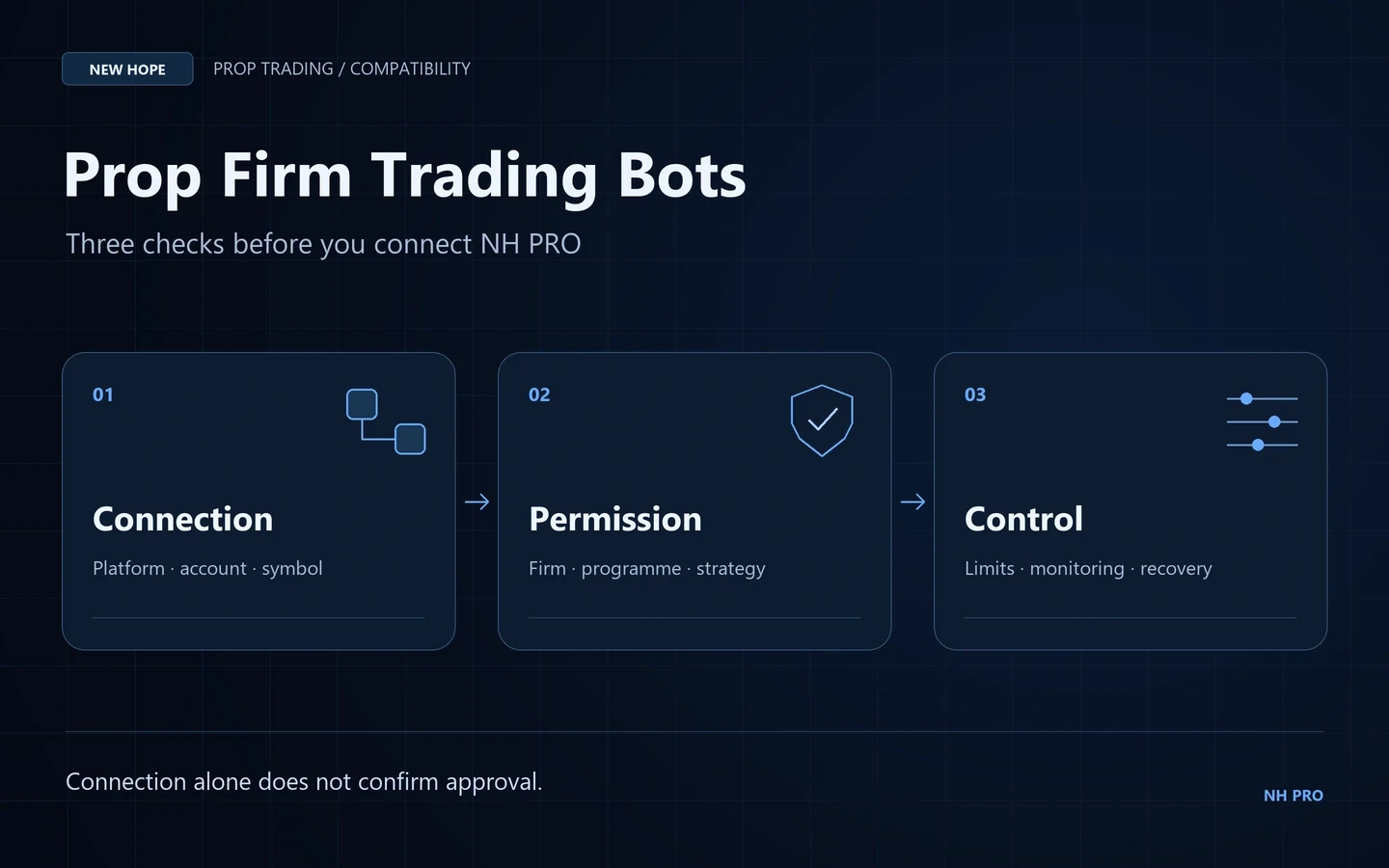
Start with our prop-firm bot compatibility checklist if either contract is still unclear. For the available software and assistance, consult the NH PRO product page. The useful next step is a specific compatibility discussion—not a promise that two accounts make prop trading risk-free.
More articles