Company News
Automated Stock Trading: Data, Orders and Integration Checks

Updated October 14, 2026. In the original article dated April 10, 2021, New Hope announced work related to stock-market trading. The archive video is retained. This guide explains how to evaluate a stock-trading integration; it does not establish current NH PRO or NH Crypto compatibility with a particular stockbroker.
Start with the instrument and account
A company name on a chart does not tell you whether the transaction involves a share, another derivative or a CFD linked to its price. That distinction affects the contract specification, available actions and costs. Record the exchange or venue, currency, instrument identifier, minimum order size and trading hours.
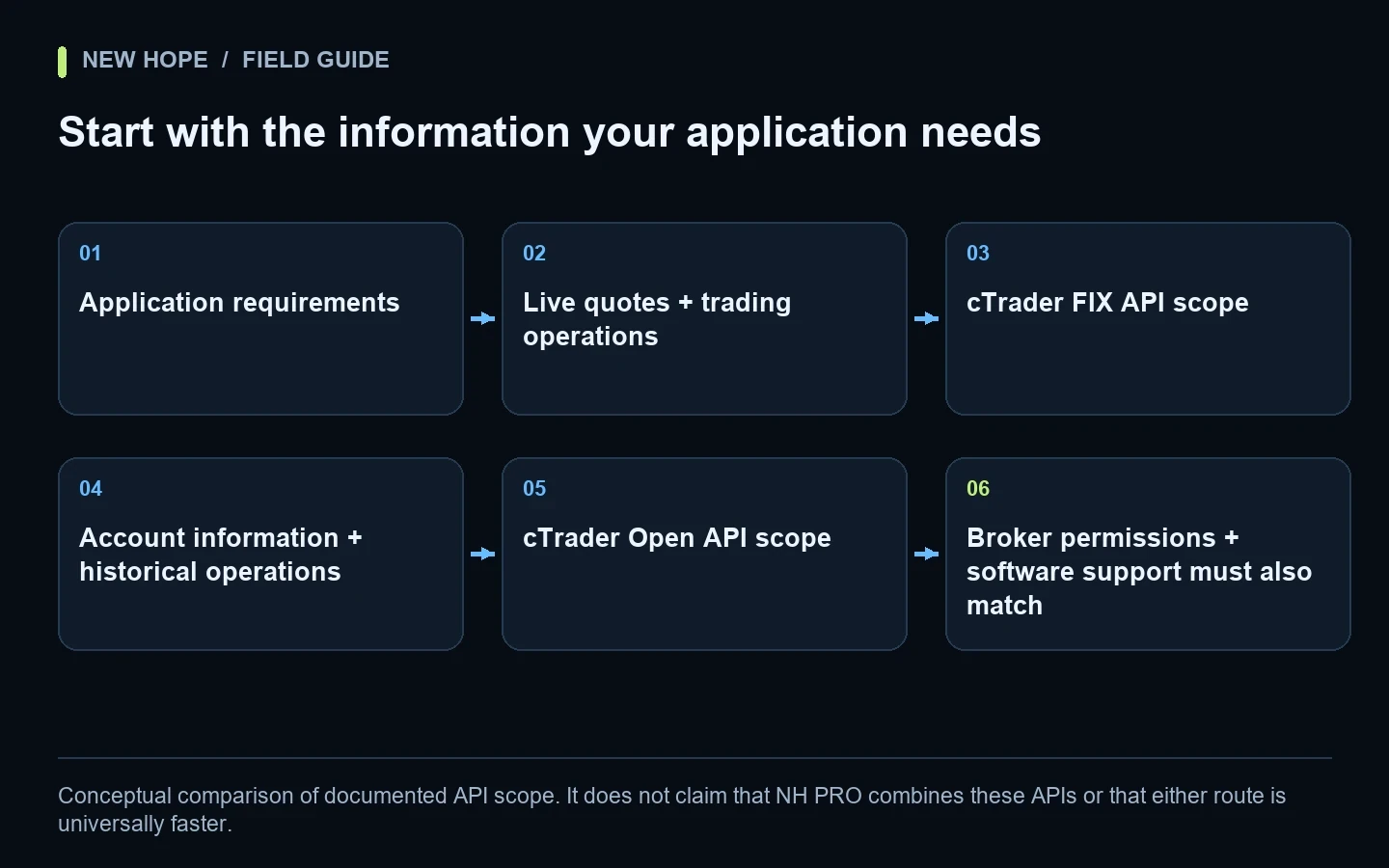
Next, separate the quote source from the order connection. A chart can update while the trading connection is unavailable. An account can also be connected without providing the required market data. A useful test checks both parts, rather than treating a moving price as proof that everything works.
Check permissions and the kind of market data
Establish whether the application receives real-time streaming data, delayed prices or individual snapshots. For example, Interactive Brokers documentation says that most securities require a relevant market-data subscription for API access. This is a broker-specific requirement, not a universal price or rule for every venue.
Before commissioning or purchasing an integration, confirm trading permissions for the relevant asset class, API access for your account and the data-use conditions. Our historical Interactive Brokers and MetaTrader 5 integration case describes an earlier development task. Its old limits and module descriptions need to be checked against current conditions.
An order and a fill are different records
A bot signal is not a completed trade. Between the two are an order submission, acknowledgement and one or more fills. The requested quantity may fill only partially. A cancellation also needs confirmation: sending a cancellation request does not by itself prove the order has left the market.
The Investor.gov explanation of execution notes that prices can change while an order travels to its execution venue. Our guide to market and limit orders for bots explains the distinction between restricting price and prioritizing execution.
An example of reconciling a partial fill
A system sends an order to buy 100 shares. The log records two fills: 40 at 25.10 and 60 at 25.12. The cost before commission is 40 × 25.10 + 60 × 25.12 = 2,511.20, giving an average price of 25.112. Two fills do not mean two orders for 100 shares. With no other trades, the resulting position must contain exactly 100 shares.
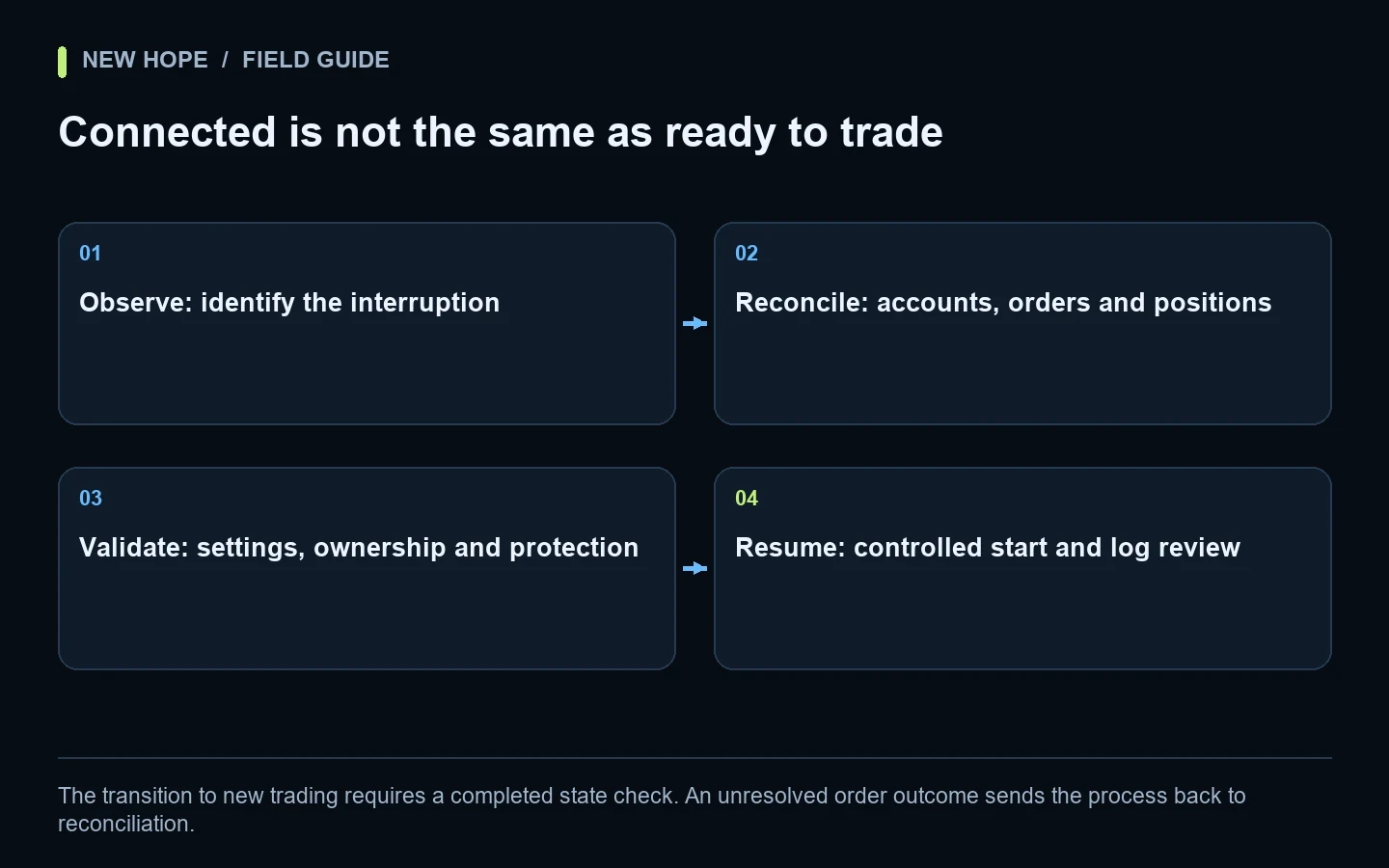
Now test reconnection. Receiving those same records again must not add another 100 shares to the local position record. Reconcile order and execution identifiers with the broker's state. These are hypothetical numbers for an accounting check, not a strategy-performance example.
Checks before using real money
Confirm the account and testing environment.
Verify the instrument identifier, currency and trading session.
Reconcile the order, partial fills, remaining quantity and final position.
Test rejections, cancellation and reconnection without duplicated actions.
Include commissions and other applicable costs in the final calculation.
Define a stop condition in advance, such as lost data, a position mismatch or an agreed risk limit being exceeded.
A demo environment helps test interactions, but execution conditions may differ. Use the demo-versus-live comparison protocol and our trading-bot execution audit to keep observations comparable.
What to include in an integration enquiry
In your enquiry to New Hope, specify the broker, account type, instruments, API and intended workflow: data collection, testing or order submission. Do not include passwords or secret keys. A precise requirement list helps establish feasibility; an archived video is not a promise that a ready-made connection is available.
More articles